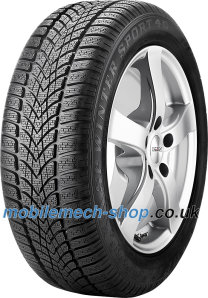
Superb winter handling and grip for high performance cars
Dunlop SP WinterSport 4D offers exceptional grip in all winter conditions.
- Exceptional performance on winter roads
- Enhanced snow and ice traction
- Control and grip in wet conditions
- Fuel efficient design
Description:
The WinterSport 4D offers excellent grip, handling and braking in all winter driving conditions (Snow, Ice, wet and Dry Below 7º). The Low Weight Construction provides low Rolling Resistance performance leading to improved fuel consumption. Superb winter handling and grip for high performance cars: Exceptional performance on winter roads, enhanced snow and ice traction, control and grip in wet conditions and fuel efficient design.
Technology (Features):
- New 4D Sipe system, a further development of the winning WinterSport 3D technology
- New “V” shape grooves and Deep Snow Notches, for excellent Snow performance
- Tread compound with functionalised polymers, for excellent Wet and Ice performance
- Dunlop Touch Technology
Directional Tread Design. Designed for those cold wet morning drives, the directional tread design forces the water between the grooves. Water is quickly channeled away from the tyre surface, reducing the risk of aquaplaning.Benefits Reduced risk of aquaplaning.
Consumer benefits:
- Better cornering in both wet and dry conditions
- Excellent grip on snow
- Very good wear resistance
- Run on flat
- Excellent grip and control at high speeds on all surfaces
Enhanced snow and ice traction. The unique tread design puts a high number of biting edges in contact with the road, giving you enhanced traction on snow and ice. Deep snow notches grab onto the surface, adding extra grip when accelerating, braking and hill climbing.
Exceptional performance on winter roads. The SP Winter Sport 4D provides exceptional winter handling and braking ability for high performance cars. Combining a unique tread design with high grip materials, it is designed to deliver optimal control on snow, ice, wet and dry surfaces.
Control and grip in wet conditions. For days when roads are wet or thawing, the SP Winter Sport 4D features directional grooves designed to evacuate water quickly and prevent aquaplaning. The high grip compound is optimised to deliver shorter braking distances on wet roads.
Fuel efficient design. With its lightweight construction and materials, the SP Winter Sport 4D requires less energy to roll – which means lower fuel costs and CO2 emissions from your journeys.
Specific bead seat system. Strengthens the link between tyre and rim for a more precise driving experience. Like the grip between your hand and the steering wheel, the Specific Bead Seat System enhances control and conveys outstanding road feedback.Benefits Enhanced road feedback; greater stability and precision.
Silica-Plus Compound. A motorsport derived tread compound that delivers high levels of grip, particularly on wet roads and in low temperatures.Benefits Superb braking and acceleration performance; high grip in wet and cold-weather conditions; low wear and tear.
Jointless Belt (JLB). A Hybrid Overlay Technology that reduces circumferential deformations at high speeds.Benefits Superior high speed stability
Maximum Flange Shield (MFS). A rim flange protection system. MFS employs a profile of rubber that runs around the circumference of the tyre above the wheel flange. This creates a protective buffer zone.* Benefits Protects expensive alloy wheels from kerbing.* Only available in select sizes
4D Sipe System. The 4D Sipe system sees the tread separated into a number of blocks that increase friction and stability during cornering. The system delivers superb lateral grip in snow.Benefits Superb cornering, even in snow.
Variable land to sea ratio. Asymmetric tread design with a variable land to sea ratio delivers high levels of aquaplaning resistance. The massive outer shoulder block ensures rapid and turbulence free water drainage, while also ensuring outstanding cornering stability.Benefits High aquaplaning resistance; increased road contact; enhanced cornering stability and steering precision.
Flatter tread profile. The new generation of Dunlop tyres features a flatter tread profile with a 4-8% bigger contact patch, depending on size and type of tyre. A bigger contact patch delivers more stability and enhanced road feedback, allowing tires to respond quickly and precisely.Benefits Increased stability and steering precision; reduced heel and toe wear; excellent cornering stability and precision; superior dry grip.
Multi Blade System. Winter driving conditions can vary greatly. From cold and dry to snow or sleet, these conditions make very high demands on a tyre. Dunlop’s multiple blade system meets this challenge head on, with different types of blades for varying winter road conditions. Benefits Consistent performance in various winter conditions.
Functional Polymers. Functional Polymers in the tread compound produce enhanced performance characteristics at low temperatures, improving road adhesion when winter temperatures plummet.Benefits Exceptional grip at low temperatures.
Multi Radius Tread (MRT). MRT designs employ ten different radii and are therefore more precise. This results in highly effective pressure deployment on the road contact patch. The effect is smoother transitions from straight to corner, leading to more precise and progressive reactions.Benefits Significantly better control over the evolution of the footprint in all driving conditions; responsive wet and dry handling; increased cornering control.
Foam-in-Tyre Technology (FIT)
Car interior noise has 3 main causes:
Wind noise (created by air-flow at high speed)
Engine noise
Tyre noise:
Tread/block road rumble. “Airpumping” also known as “groove resonance” , where the grooves are compressed and then released again. (Structural) Vibrations of the tyre/carcass.
Foamin Tyre(FIT)
Tyre noise
'Why Foam-in-Tyre?'
Tyre noise is mainly transmitted by:
- Airborne noise: Noise waves transmitted through air
- Body noise: Transmission by vehicle suspension
One of the biggest noise sources, is the so-called Cavity Resonance which is transmitted into the car as body noise because of the axle construction.
Foamin Tyre (FIT)
Technology
'How does Foamin Tyre work'
Technology:
Once the tyre has been heated, a foam strip is fitted to the inner liner. This reduces tyre (carcass) noise considerably.
Principle of operation:
- Elimination of resonance peaks.
Effect:
- Reduction of interior car noise by a number of dB, to half of the tyre noise.
Advantages:
- Relatively cost efficient
- Stable through the full life of the tyre
- Light enough not to influence running performance, roll resistance or high speed efficiency
- Currently available in Summer and Winter, also as All Season and ROF later.
- Can be repaired
Effect of the tyre on noise perception
Sounds are transmitted by 2 main mechanisms: By air movement (Air resonance): The air molecules are stimulated to vibrate (wave form).
By structural resonance (Body resonance): Vibrations are transmitted by the vehicle structure.
A large part of inerior car noise is due to resonance caused by vibration of the tyres. This is transmitted to the inside of the car via the structure (body resonance). Counter measures taken at noise source, in this case, at the tyre, are easier and more effective than they would be at other car components, e.g. at the drive train or the body.
The solution
How can the vibrations in the tyres be reduced?
Fitting a foam strip to the inner liner of the tyre helps to markedly reduce the tyre (carcass) noise. Reduced resonance in peak range by up to 11dB(A) This makes a reduction of interior car noise of up to 3 - 4dB(A), possible. This means that it is only half as loud in the car as it would have been with normal tyres.
.







 %service-partner-advantages-list%