We use cookies to personalize content and ads, provide social media features, and analyze traffic. In addition, we provide social media, advertising, and analytics partners with information about how you use our website. If you continue to use our website, you agree to our cookies.
Managing cookie setting
In order to offer you an optimal experience with the site, we use cookies. These are small text files that are saved on your computer. These include cookies for the operation and optimization of the page, as well as for services such as text or video chat, as well as for advertising based on your behavior on the Internet. For example, you can find out if you visit our website several times from the same device. We want to give you a choice of which cookies you allow:
Mandatory cookies
These cookies are necessary for navigating pages and using basic functions
necessary
Analytical cookies, marketing cookies, services of other companies (independent third-party providers)
Analytical cookies
These cookies help us better understand user behavior.
No
Yes
Marketing cookies
These cookies and similar technologies are used to display personalized and therefore relevant advertising content.
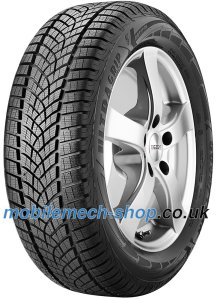
Reduced risk of aquaplaning Hydrodynamic grooves help to channel the water away from the tire surface - to reduce the risk of aquaplanning and improve traction on melting snow.
Excellent braking distance on snow Benefit from shorter braking distance when it matters most - thanks to Goodyear's SnowProtect Technology for superior winter performance.
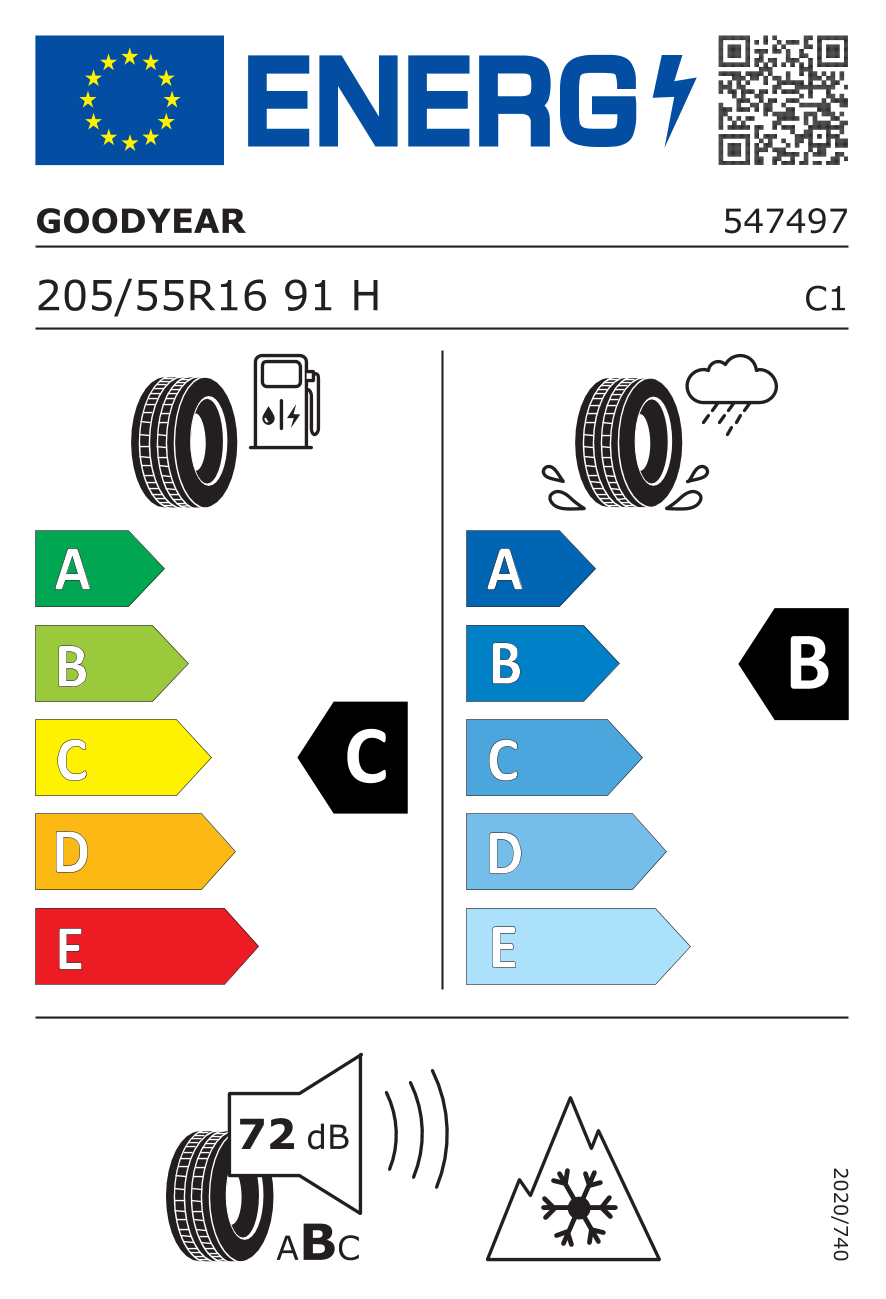
The Tire Labeling Ordinance specifies the information requirements on fuel efficiency, wet grip and external rolling noise from tires. In addition, reference is made to the winter properties of the product.
The EU 1222/2009 regulation that has been in force since November 1st, 2012 has been revised and will be replaced by regulation EU 2020/740 from May 1st, 2021; From this point on, new requirements apply. The rating classes for fuel efficiency, wet grip and exterior noise have been changed and the layout of the EU label has been adjusted. The manufacturer's product data sheets stored in the EU database can be downloaded via a QR code integrated into the label. Information on snow grip and ice grip is also newly included for tires that meet these criteria.
The following tires are exempt from the regulation: - tires that are designed exclusively for installation on vehicles that were first registered before October 1, 1990 - retreaded tires (until a corresponding extension of EU VO 2020/740 has taken place) - professional off - Road tires - Racing tires - Tires with additional devices to improve traction, eg studded tires - T-type emergency tires - Tires with a permissible speed below 80 km/h - Tires for rims with a nominal diameter ≤ 254 mm or ≥ 635 mm
The criteria and evaluation classes at a glance
fuel efficiency
The fuel consumption depends on the rolling resistance of the tyres, the vehicle itself, the driving conditions and the driving style of the driver. The measured rolling resistance (rolling resistance coefficient) of the tire is divided into classes A (highest efficiency) to E (lowest efficiency).
If a vehicle is completely equipped with class A tires, a consumption reduction of up to 7.5%* is possible compared to class E tyres. In the case of commercial vehicles, it can even be higher. (Source: European Commission Impact Assessment * when measured according to the test methods set out in Regulation (EU) 2020/740)
Please note: Fuel consumption depends to a large extent on your own driving style and can be significantly reduced by driving in an environmentally friendly manner. Tire pressure should be checked regularly to improve fuel efficiency.
wet grip
Wet grip is divided into classes A (shortest braking distance) - E (longest braking distance).
If a car is equipped with class A tires, compared to class E tires, a braking distance of up to 18 m can be reduced when braking from 80 km/h (on a road surface with average grip).* *Source: wdk Economic Association of the German Rubber Industry eV
Please note: Traffic safety depends to a large extent on your own driving style. The stopping distances must always be observed. Tire pressure should be checked regularly to improve wet grip.
External rolling noise
The noise emitted by a tire affects the overall volume of the vehicle and affects not only your own driving comfort, but also the noise pollution of the environment. In the EU tire label, the external rolling noise is divided into 3 classes from A (lowest rolling noise) - C (highest rolling noise), measured in decibels (dB) and compared with the European noise emission limit values for external tire rolling noise.
A The pictogram with the classification "A" indicates that the tire's external rolling noise is more than 3 dB below the EU limit value in force until 2016. B The "B" classification means that the tyre's external rolling noise is up to 3 dB below or equal to the EU limit value in force until 2016. C The classification "C" indicates that the specified limit value is exceeded.
UltraGripPerformanceGEN-1 tyre review
Average based on 12 test results
Grip in dry conditions
Braking in dry conditions
Grip in wet conditions
Braking in wet conditions
Grip in snow
Driving comfort
Internal noise level
Tyre wear
Fuel consumption
Kilometers driven153,263
08.06.2019fromMark Hobba Outstanding tyres. I researched winter tyres thoroughly online, looking at many comparison tests, and picked these. And they have lived up to my expectations. Highly recommended.
28.05.2019fromDarren We have had winter tyres fitted to our main family car for the last 8 years and are total converts to their benefits. This was the first year I have worked as a chauffeur and didn't hesitate to have them fitted. All Mercedes vehicles wear tyres out in certain areas before the whole tyre is ready for replacement, due to their steering geometry settings. The winter tyres have outlasted the 'summer' tyres in this aspect and are still fitted to the vehicle despite temperatures now remaining above the optimum seven degrees.
I totally recommend these tyres and will have them fitted next winter.
21.05.2019fromMIKE Not too sure about the breaking properties of tyres - I tend to have more interest in their braking properties. That aside, these tyres give extra confidence on snow and cold wet roads, but once the temperature starts to increase in Spring, there is the usual drop off of performance - as expected. Just switched back to Summer tyres after the second season with these Goodyears, and still 7 to 8mm tread depth left - more than you get with some NEW tyres.
21.05.2019fromMIKE Not too sure about the breaking properties of tyres - I tend to have more interest in their braking properties. That aside, these tyres give extra confidence on snow and cold wet roads, but once the temperature starts to increase in Spring, there is the usual drop off of performance - as expected. Just switched back to Summer tyres after the second season with these Goodyears, and still 7 to 8mm tread depth left - more than you get with some NEW tyres.
*Prices include VAT and delivery within mainland UK (excl. Scottish Highlands). Additional shipping fees may apply to selected postal codes. Any applicable shipping costs will be displayed in the checkout process.
**More than 90% of our orders reach the customer in the specified delivery time.







 %service-partner-advantages-list%