We use cookies to personalize content and ads, provide social media features, and analyze traffic. In addition, we provide social media, advertising, and analytics partners with information about how you use our website. If you continue to use our website, you agree to our cookies.
Managing cookie setting
In order to offer you an optimal experience with the site, we use cookies. These are small text files that are saved on your computer. These include cookies for the operation and optimization of the page, as well as for services such as text or video chat, as well as for advertising based on your behavior on the Internet. For example, you can find out if you visit our website several times from the same device. We want to give you a choice of which cookies you allow:
Mandatory cookies
These cookies are necessary for navigating pages and using basic functions
necessary
Analytical cookies, marketing cookies, services of other companies (independent third-party providers)
Analytical cookies
These cookies help us better understand user behavior.
No
Yes
Marketing cookies
These cookies and similar technologies are used to display personalized and therefore relevant advertising content.
The efficiency class label evaluated based on customer preferences. Delticom centralized survey results from more than 40.000 customers from 15 European countries and created this index.
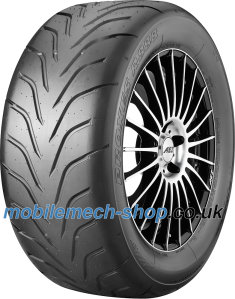
The new competition radial, TOYO Proxes R888 has been developed to deliver maximum dry handling and quick lap time for the racing events, such as competition or 'Track day' events. Low Heat Generation. Cap and base tread construction minimizes heat-build-up and prevent tread compound from deterioration, maintaining its handling capabilities for longer distance.
Enhanced R-Compound Tread
Maximizes grip for better competitive handling and performance.
Unidirectional V-Shaped Tread Design
Increased tread area and limited void improves dry traction V-shaped grooves assist with wet traction.
Continuous Center Contact
Increases braking performance and dry traction.
Semi-Slick Shoulder Area
Improves grip for better steering response.
Stiff Bead Construction And Wider Tread Width
Increases cornering force for better competitive handling.
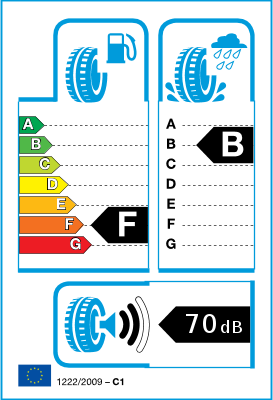
The Tire Labeling Ordinance specifies the information requirements on fuel efficiency, wet grip and external rolling noise from tires. In addition, reference is made to the winter properties of the product.
The EU 1222/2009 regulation that has been in force since November 1st, 2012 has been revised and will be replaced by regulation EU 2020/740 from May 1st, 2021; From this point on, new requirements apply. The rating classes for fuel efficiency, wet grip and exterior noise have been changed and the layout of the EU label has been adjusted. The manufacturer's product data sheets stored in the EU database can be downloaded via a QR code integrated into the label. Information on snow grip and ice grip is also newly included for tires that meet these criteria.
The following tires are exempt from the regulation: - tires that are designed exclusively for installation on vehicles that were first registered before October 1, 1990 - retreaded tires (until a corresponding extension of EU VO 2020/740 has taken place) - professional off - Road tires - Racing tires - Tires with additional devices to improve traction, eg studded tires - T-type emergency tires - Tires with a permissible speed below 80 km/h - Tires for rims with a nominal diameter ≤ 254 mm or ≥ 635 mm
The criteria and evaluation classes at a glance
fuel efficiency
The fuel consumption depends on the rolling resistance of the tyres, the vehicle itself, the driving conditions and the driving style of the driver. The measured rolling resistance (rolling resistance coefficient) of the tire is divided into classes A (highest efficiency) to E (lowest efficiency).
If a vehicle is completely equipped with class A tires, a consumption reduction of up to 7.5%* is possible compared to class E tyres. In the case of commercial vehicles, it can even be higher. (Source: European Commission Impact Assessment * when measured according to the test methods set out in Regulation (EU) 2020/740)
Please note: Fuel consumption depends to a large extent on your own driving style and can be significantly reduced by driving in an environmentally friendly manner. Tire pressure should be checked regularly to improve fuel efficiency.
wet grip
Wet grip is divided into classes A (shortest braking distance) - E (longest braking distance).
If a car is equipped with class A tires, compared to class E tires, a braking distance of up to 18 m can be reduced when braking from 80 km/h (on a road surface with average grip).* *Source: wdk Economic Association of the German Rubber Industry eV
Please note: Traffic safety depends to a large extent on your own driving style. The stopping distances must always be observed. Tire pressure should be checked regularly to improve wet grip.
External rolling noise
The noise emitted by a tire affects the overall volume of the vehicle and affects not only your own driving comfort, but also the noise pollution of the environment. In the EU tire label, the external rolling noise is divided into 3 classes from A (lowest rolling noise) - C (highest rolling noise), measured in decibels (dB) and compared with the European noise emission limit values for external tire rolling noise.
A The pictogram with the classification "A" indicates that the tire's external rolling noise is more than 3 dB below the EU limit value in force until 2016. B The "B" classification means that the tyre's external rolling noise is up to 3 dB below or equal to the EU limit value in force until 2016. C The classification "C" indicates that the specified limit value is exceeded.
PROXESR888 tyre review
Average based on 11 test results
Grip in dry conditions
Braking in dry conditions
Grip in wet conditions
Braking in wet conditions
Grip in snow
Driving comfort
Internal noise level
Tyre wear
Fuel consumption
Kilometers driven38,991
19.11.2012fromR K Paul For such a low treadwear rating I wasn't expecting the tyre to last as long as it has. It seems to still have some tread on it even after 7000 miles. The intrusive and continual whining/howling of road noise is the only negative but a totally acceptable compromise considering the immense cornering abilities and traction. My 1980s BMW could easily outhandle a modern BMW M6. Even the wet weather grip was good. No more tail out antics however, grip is now too good for that!
17.07.2012fromNick The best tyre money can buy, as simple as that!
20.01.2011fromJulz As a track tyre for dry or mildly damp conditions these are pretty good. However, the increase in price makes other (better) tyres a more logical choice. They warm up well and quickly, tolerate a fair amount of abuse and the very stiff sidewalls makes them very predicatable with superb feel and bite. Very high wear rate though. and once the track is more than mildly wet they loose temprature and ggrip very quickly...And when cold (or less than optimum temprature) they have a very sharp and sudden break-away point.
12.09.2010fromBabak Hadi Very good semi slick. I find the tyre gets a bit grasy on hot days once warmed up. Best times during first three laps after that tyre becomes too soft.







 %service-partner-advantages-list%